Why Your Columbus Facility's Floor Is Quietly Costing You Thousands
Why Your Columbus Facility's Floor Is Quietly Costing You Thousands | North Coast Lift Truck: a Coric Equipment Company
Columbus facility managers: cut floor replacement costs, reduce slip-and-fall risk, and rent industrial floor scrubbers and sweepers from North Coast LIft truck. Free assessment available.
Walk into any warehouse, distribution center, or commercial facility in the Columbus area and you'll find the same overlooked asset underfoot: the floor. It carries every forklift pass, every foot of daily traffic, and every safety inspection; yet, most facilities only think about it once something goes wrong.
That reactive approach has a price tag. Here's what the data says about the true cost of ignoring floor care, and how a structured maintenance program changes the math for facilities across central Ohio.
The Hidden Cost of "We'll Deal With It Later"
Floor replacement is one of the largest unplanned capital expenses a facility manager can face. Depending on the flooring type, replacement runs $3 to $15 per square foot installed. For a mid-sized 50,000-square-foot facility, that can be an unplanned cost that can range from $150,000 to $750,000.
Floor damage doesn't announce itself. Surface degradation, staining, coating failure, and micro-cracking build up slowly and invisibly until the floor crosses a threshold where repair is no longer an option. At that point, there's no time to plan or budget. The expense just happens, on the facility's worst possible timeline.
Four cost categories compound quietly in the background:
Direct replacement costs include materials, labor, and the operational downtime of taking a zone offline, which can rival the material cost itself. Accelerated wear means a floor that could last 15 years under a proper maintenance program hits end-of-life in as little as six to eight years without one, roughly doubling how often you're paying for a full replacement. Safety and liability exposure is significant: slip-and-fall incidents remain one of the top three causes of workplace injury claims nationally, and neglected floors are a primary driver. Compliance risk rounds it out — in healthcare, food service, and manufacturing environments, floor condition is often part of the regulatory inspection itself, and a failed inspection means remediation costs and reputational damage on top of any fine.
The bottom line: maintaining a floor is consistently cheaper than replacing one.
What a Real Floor Care Program Actually Includes
There's an important distinction between a cleaning contract and a professional maintenance program. Cleaning handles appearance, it clears visible dirt and keeps a space presentable. A maintenance program goes further, applying the right equipment, chemistry, and technique to your specific floor type on a defined schedule, with the goal of protecting the surface and extending its usable life.
A well-built program typically includes routine and periodic elements.
On the routine side: machine scrubbing scheduled around actual traffic volume and floor type, burnishing to preserve the integrity of polished surfaces, spot treatment for spills before they set into the material, and regular inspections that catch developing issues early.
Periodic deep care covers strip-and-recoat cycles to restore protective layers on coated floors, resealing high-traffic zones before wear turns into damage, equipment calibration to match pad pressure and chemical dilution to the surface, and documentation that supports compliance and long-term capital planning.
The right program depends entirely on the facility. A distribution center with heavy forklift traffic on polished concrete needs a different approach than a healthcare corridor with vinyl composition tile. Applying the wrong program can accelerate damage, which is why a facility assessment is so important before implementing a maintenance plan.
The Numbers, By Floor Type
The gap between a reactive and structured approach shows up clearly once you look at a specific floor types. A concrete warehouse floor left on a reactive schedule typically needs full resurfacing every five to seven years at $3 to $5 per square foot, a structured program stretches that lifecycle to 10-15 years and cuts resurfacing frequency by more than half. Vinyl composition tile (VCT) tells a similar story: without a program, facilities are stripping and waxing annually at $0.40 to $0.80 per square foot and still replacing tile within eight to ten years, while scheduled scrubbing and recoating under a program pushes that tile's usable life to 15 to 20 years. Epoxy coated floors normally need recoating every three to five at $2 to $4 per square foot without maintenance; a proper program extends that recoat cycle to 8 to 12 years and reduces the associated cost by 40% to 60%. Polished concrete is especially sensitive to neglect, micro-scratches can dull the finish within just two years without care, but a maintained gloss can reduce slip hazards and eliminate the refinishing cycle altogether. And high-traffic entry points and loading zones, which often need replacement every four to six years at $6 to $10 per square foot installed, see their wear rate slowed enough under a structured programs to extend zone life to 10-15 years.
The Safety Math Most Budgets Miss
Floor care is a capital-planning issue, but more importantly, it is a safety one. National data attributes roughly two million slip-and-fall incidents a year to hazardous floor conditions, and the fully loaded cost of a single incident: medical treatment, workers' comp, legal exposure, lost productivity, and insurance impact, typically runs $20,000 to $40,000.
A facility without a structured program isn't unusual in seeing two to three of these incidents a year, translating to $40,000-$120,000 in annual incident-related cost that rarely gets traced back to the maintenance decision behind it. Facilities that run structured floor care programs see up to 40% fewer slip-and-fall incidents than those on a reactive schedule, a meaningful reduction against five-figure cost per event.
Building the Business Case in Five Steps
If you need to make this case to a CFO, VP of Operations, or procurement committee, here's a framework that works:
Step One: Inventory your floor assets. Document every floor type, square footage, age, and condition, plus when each zone last received professional attention. This baseline reveals your actual deferred maintenance exposure.
Step Two: Calculate your current replacement trajectory. Estimate when each zone will need resurfacing or replacement and apply realistic cost-per-square-foot figures across a 10-year horizon. That total is your baseline capital exposure.
Step Three: Model the program alternative. A maintenance program adds annual operating cost but typically extends replacement cycles by 1.5 to 3 times the reactive cycle. The gap between the two totals is your financial justification.
Step Four: Layer in safety and compliance value. Even a conservative 20% reduction in incident frequency produces measurable savings. In regulated environments, a single compliance failure can exceed a full year of program costs on its own.
Step Five: Present total cost of ownership. Frame the program as a comparison against the reactive alternative, not as new spend against a "free" status quo. The status quo has costs — they're just hidden until they can't be any longer.
What to Look For in a Floor Care Partner
Outcomes vary widely based on who's doing the work. Before signing with any provider, ask:
Do they use commercial-grade equipment calibrated to your specific floor type, or generic consumer-grade tools? Are technicians trained on pad selection, machine speed, and pressure settings by floor type? Is the chemistry pH-matched to your coating, because the wrong chemistry can strip protective finishes and void manufacturer warranties? Do they document each visit: what was done, what was observed, and what follow-up is recommended? Do they offer a defined maintenance schedule, or only ad hoc service when something's already wrong? Do they understand the compliance standards specific to your industry, distribution, manufacturing, healthcare, or food service?
Industrial Floor Scrubber and Sweeper Rentals in Columbus, OH
Not every facility needs a full-time machine, and not every floor care need justifies a capital purchase. North Coast Lift Truck rents industrial floor scrubbers, commercial floor sweepers, and warehouse cleaning equipment to facilities across Columbus
and Central Ohio on short-term and long-term rental plans.
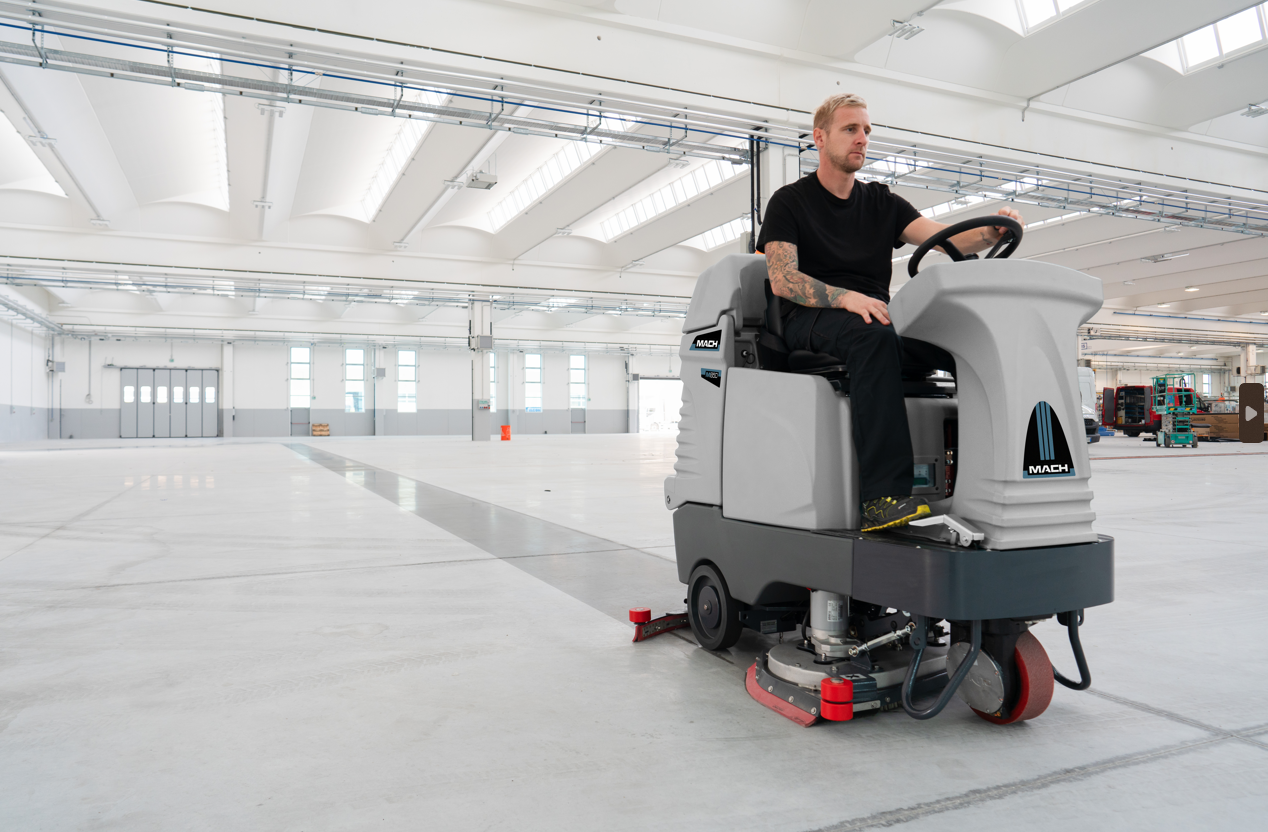
Whether you need a walk-behind automatic scrubber for a one-time deep clean, a ride-on floor scrubber for an ongoing maintenance rotation, or a commercial floor sweeper to keep high-traffic warehouse zones clear between service visits, our rental fleet is stocked and available.
All rental equipment is commercial-grade, the same machines our technicians use in professional maintenance programs. No consumer-grade substitutes, no guesswork on whether the machine matches your floor type. Our team will match the right equipment to your surface before it leaves our facility.
Columbus-area floor scrubber and sweeper rentals are available for:
Warehouse and distribution center floors, concrete and polished concrete surfaces, VCT and epoxy-coated floors, healthcare, food service, and manufacturing facilities, and short-term project needs alongside long-term maintenance programs.
We also sell industrial scrubbers, sweepers, and floor care machines to Columbus-area facilities that want a machine on-site between scheduled service visits.
Ready to rent? Contact our Columbus team for same-day and next-day availability on select equipment here, or explore our full floor care rental options here.
Serving Columbus Facilities With a Program Built Around Your Floors
North Coast Lift Truck provides professional floor care programs to commercial and industrial facilities across Central Ohio, built around your specific floor type, traffic patterns, and compliance requirements, rather than offering a generic service checklist. Every program starts with a facility assessment, because a plan built without understanding your floor isn't a plan, it's a guess.
Our technicians are trained across the full range of commercial and industrial surfaces -polished concrete, VCT, epoxy coating, sealed concrete, and specialty flooring used in healthcare, food service, and manufacturing environments. And if your team needs equipment on hand between service visits, we also rent and sell industrial scrubbers, sweepers, and floor care machines to Columbus-area facilities.
Your floor. Our Standard.
Ready to see what a structured program could save your facility? Request your free facility floor assessment and we'll evaluate your floor types, current condition, and maintenance history, then build a plan that extends floor life, reduces capital exposure, and keeps your facility safe and compliant.
This article is intended for informational purposes. Cost estimates and maintenance outcome figures represent general industry ranges based on floor type, facility use, and maintenance history. Actual results will vary by facility. Contact North Coast Lift Truck for a customized assessment.